


Uttarakhand - A scenic Beauty and Incredible cuisine

Updated: May 12
Being a Uttarakhandi, I’m proud to have been part of something I had never done before. For me, knowing our cuisine—our food—is the same as knowing our roots.
After joining Courtyard & Fairfield by Marriott, Outer Ring Road, Bellandur, Bangalore, I got the opportunity, as part of a team, to create a brunch based on an Uttarakhand theme—something I had never done as a chef. Having cooked international cuisine for a long time, I had almost forgotten the food that connects me to my roots.
I haven’t visited my native place often, but recently I got the chance to visit my village, Pokhri Gaon, in the Pauri district of Uttarakhand. This time, it felt different—the calm Himalayan mountains, the small and beautifully crafted houses, and the lush green forests together felt breathtaking, like a spiritual retreat
And then comes the food—Uttarakhand’s cuisine reflects the region’s unique geography, culture, and traditions. The food of Uttarakhand is simple yet full of flavor, made with locally sourced ingredients that have sustained its people for centuries. Exploring Uttarakhand cuisine reveals a world of hearty meals, aromatic spices, and traditional cooking methods—deeply connected to the land and its people

The Foundation of Uttarakhand Cuisine
Uttarakhand cuisine is shaped by the mountainous terrain and the availability of fresh, natural ingredients. The diet is largely vegetarian, with occasional use of dairy products and locally hunted meat. The food emphasizes simplicity, nutrition, and warmth, perfect for the cold climate of the hills.
The ingredients are very simple and easily accessible, but some of the ingredients you will only get in Uttarakhand Only. The ingredients widely used in Uttarakhand Cuisine are -
Millets and grains such as mandua (finger millet), jhangora (barnyard millet), and rice.
Local pulses and lentils like black gram and green gram.
Seasonal vegetables including leafy greens, radishes, and gourds.
Dairy products such as curd, ghee, and buttermilk.
Herbs and spices like cumin, coriander, ginger, garlic, and locally grown chilli.

COOKING TECHNIQUES & INGREDIENTS USED BY THE LOCALS THEIR -
In old times, the people there used different cooking methods, utensils, and equipment, which apparently gave the real authentic taste to their food as well.

1. Bhaddu / Pathar Cooking –
Bhaddu is a thick-bottomed pot made of local stone/clay. Food is simmered for hours on wood fire.

Used for: Kafuli, Phanu, Jholi.
Why special: Stone retains heat, cooks evenly at low temp. Gives earthy flavor you can’t get in steel.
2. Jakhya / Jhambu
Instead of rai/jeera, they use jakhya – wild mustard seeds that pop like mini crackers. Jhambu is a Himalayan dried herb like chives.
Used for: Almost every dal, sabzi, raita. Aloo ke gutke without jakhya aren't authentic.
Technique: Heat mustard oil to smoking, add jakhya. It crackles in 3 seconds. Add dried red chili + jhambu. Immediate aroma.
Flavor: Nutty, sharp, different from regular tadka.
3.Sil-Batta Grinding – Still, if you go there, you will find
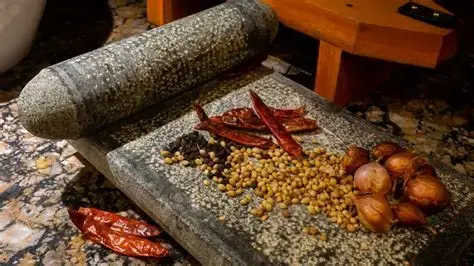
the local ladies using this technique to make paste, grinding masalas, dal on sil batta rather than mixer grinder. Especially when it comes for making Bhang ki Chutney, Til ki Chutney, Chainsoo Paste.
It gives coarse texture, and also the heat from releasing oil when grinding mustard seeds and til gives moisture and helps in making paste.
4. Lota / Kadhai Dum – Food sealed with atta dough and cooked on a low flame, often buried in chulha ash.
Used for: Kafuli – spinach + fenugreek saag, Dubuk – bhatt dal.
5. Drying & Fermentation – In old times, people of Uttarakhand were also able to think ahead as they had challenges like a short growing season, harsh winters, and no refrigeration for centuries. So, Uttarakhand's food culture adopted two techniques:
Sukhana - Drying
Khatta Karna - Fermentation
And both add flavor and nutrition.
Now how they do it at that time, or I would say, still they are doing in many parts of Uttarakhand. They use summer's sun or winter's stove to preserve, flavor, and nutrition. They used to dry Kandali, Lai, Saag, Lingda, Arbi Ke Danthal, Sukhi Badi.
For example - When I visited my Pokhri Gaon, I saw one lady blanching the kandali for 2 to 3 minutes and then she put it on their rooftop. I checked with her for how many days or hours she will keep it. She replied that she will keep it for 4 to 5 days and then in winter times she will rehydrate and will make lingda ki subzi with jakhiya. I was amazed that the same things we adopt in modern techniques and are doing far away from them.
While I was exploring the food culture of Uttarakhand cuisine in Pokhri Gaon, a beautiful view came in front of us and I couldn't stop myself from taking a picture of it.
.

Signature Dishes of Uttarakhand
1. Aloo Ke Gutke
A simple yet flavorful dish, Aloo Ke Gutke consists of boiled potatoes tossed with mustard seeds, turmeric, red chili powder, and fresh coriander. It is often served with mandua ki roti (finger millet flatbread) and a side of curd. This dish highlights the rustic flavors of the region and is a staple in many households.
2. Kafuli
Kafuli is a thick, green leafy vegetable curry made from spinach, fenugreek, or other local greens. It is cooked with ginger, garlic, and mild spices, then thickened with gram flour or rice flour. This dish is rich in nutrients and reflects the importance of greens in the Uttarakhand diet.
3. Chainsoo
Chainsoo is a unique black gram dal preparation where the lentils are roasted before cooking, giving the dish a smoky flavor. It is mashed and cooked with garlic, mustard seeds, and spices. Chainsoo is often enjoyed with steamed rice or millet rotis.
4. Bhang Ki Chutney
This spicy chutney is made from roasted hemp seeds ground with garlic, green chilies, and salt. It is a traditional accompaniment that adds a punch of flavor to meals and showcases the use of local seeds in Uttarakhand cuisine.
5. Bal Mithai
No exploration of Uttarakhand cuisine is complete without mentioning Bal Mithai, a popular sweet from the region. It is a fudge-like sweet made from roasted khoya (milk solids) coated with white sugar balls. This delicacy is a must-try for visitors and a symbol of local culinary heritage.
Collecting all these memories, I left for my home. I learned new things which I might never have known if I had not visited my village. I captured beautiful images of my village and the food culture.
TASTE OF UTTRAKHNAD THEMED BRUNCH @ COURTYARD BY MARRIOTT , BANGALORE , INDIA
As I took all the memories with me of my native place, soon I got a chance to execute also in one of our themed brunches in the hotel TASTE OF UTTARAKHAND, where my team and I put all our efforts to match the theme exactly like the cuisine of Uttarakhand.
We made the menu where we put all the famous dishes of Uttarakhand, including dessert. One of the major showcases is the pastry section, where the pastry Chef Viren Mehta made the beautiful designer cake based on the culture of Uttarakhand, which is phenomenal.
As you can see in the picture, all the designer cakes resemble the tradition and culture of Uttarakhand.
As in picture one, the chef made the beautiful Pahadi cap with fine work. This kind of Pahadi cap is worn by people during special occasions.
The second picture resembles the jewellery used to be worn by ladies, which again has very fine work.
The third picture resembles the Guloband - it's a traditional choker-style necklace, particularly significant in Kumaoni and Garhwali culture.
The team also beautifully placed the hot dishes as we transported some of the ingredients from Uttarakhand.
The chefs who made the buffet belong to various villages of Uttarakhand, and chefs from different parts of the country have helped them very enthusiastically and learned about Uttarakhand cuisine.
There were several starters from Uttarakhand which won the heart of our guests.

The dish above is an authentic recipe from Uttarakhand, made using arbi (taro) leaves.
First, wash the leaves well, then remove the thick fibrous stem and veins. Prepare a thick, spreadable batter using besan (gram flour), ginger-garlic paste, green chilies, turmeric, red chili powder, salt, and tamarind, adding a little water as needed.
Next, place one arbi leaf flat, spread a layer of the besan batter over it, then repeat the same process to create 3–4 layers. Fold the sides inward, apply a little more batter, and roll it tightly. Steam the rolls for 15–20 minutes, until the besan is fully cooked.
Once cooled, slice the rolls and pan-fry them in oil with mustard seeds.
Apart from this, the brunch also included Pahadon wali Maggi, inspired by the chatpata flavors of Uttarakhand cuisine. Pahadi Maggi is especially popular in Nainital and Mussoorie, so it had to be part of the brunch
There is a station of different chutneys whic are famous in Uttrakhand cuisine
All these chutneys are prepared authentically on Sil Batta so that our guests have the same texture, taste, and consistency as usually served in Uttarakhand.
Til Ki Chutney, Salwatte Ki Chutney, Kacche Aam Ki Chutney, Kakdi Mooli Ki Chutney, Laya Ka Lun, Bhuni Mirch, Hari Mirch, Pishu Lun—all these chutneys make a difference when having them with the main course. The chef prepares all these chutneys just as they are made in Uttarakhand.
Apart from the vegetarian spread, Uttarakhandi cuisine also has some incredible non-vegetarian delicacies made with local pahadi meat and river fish. Dishes like Kukudu Ki Sikar, Gaad Ki Macchi, and Bakra Ki Bhuni were prepared authentically by Chef Chandan and Chef Dharmendra, who have strong experience in Uttarakhandi cooking.
Kukudu Ki Sikar is a traditional and well-known dish in the thalis of the Kumaon and Garhwal regions. The chicken is slow-cooked on a low flame and served in a thick gravy—usually paired with Bhang ki Chutney, Mandua ki Roti, or Bhaat (rice).
Gaad Ki Macchi refers to fish sourced from the cold, clean Himalayan rivers. This dish has its own unique character, and the fish commonly used is trout or mahseer.
Bakra Ki Bhuni is one of the most loved and widely eaten dishes in Uttarakhandi cuisine. It’s made with liver (and sometimes small pieces of mutton), cooked slowly with mild spices. It’s especially popular in the Kumaon region, where it’s often prepared with kaleji and gurda.
Apart from the non-vegetarian dishes, the vegetarian dishes were also a star of the brunch
Usually, you will find more vegetarians in Uttarakhand than non-vegetarians, but I must say you should try both categories of food. The vegetarian includes Bhatt Ki Churkani & Kafuli. Both are very authentic dishes from Uttarakhand, which never fail to impress the guests during food festivals.
And finally, the dessert section became a special highlight for our guests—Jhangora Ki Kheer, a top-class dessert from the Himalayan mountains.
What is Jhangora? Jhangora, also known as barnyard millet, is called Saanva or Sama rice in Hindi. It’s gluten-free, highly nutritious, and widely enjoyed in Uttarakhand—served with dal, paired with meat dishes, and also prepared as a sweet dish.
For our brunch, we made Jhangora ki Kheer with mild sweetness and the beautiful aroma of cardamom, which the guests absolutely loved.

Comments